Jerome Hill
A complete artist and major patron of the avant-garde
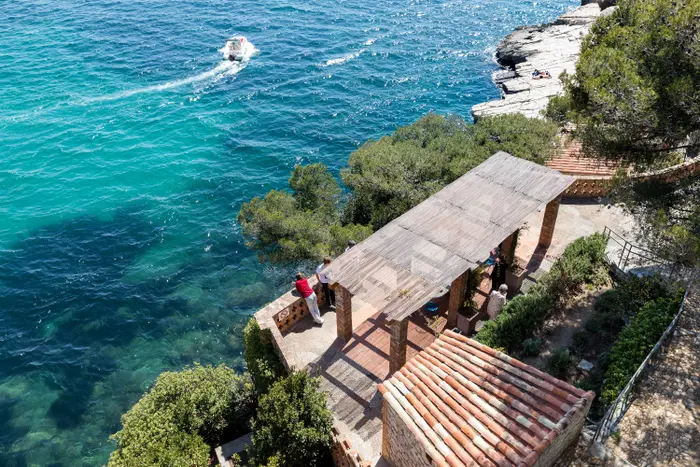
Jerome Hill, American artist and cultural patron, supported the avant-garde scene and the humanities on both sides of the Atlantic. Attracted by the beauty of the site, in a moment of artists' resort movement of the early 20th century, he acquired a property at the entrance to Cassis harbor, facing the Cap Canaille and the horizon, where he gave full rein to his creativity among a group of artists and scholars. He created a dedicated space for living, exchanging and experimenting. In 1967, the Camargo Foundation was created to ensure the continuity of the site and the purpose for which it was conceived, and for over fifty years it has welcomed international artists, scholars and thinkers to Cassis for residencies.
Jerome Hill was born in 1905 and grew up in St. Paul, Minnesota - he was the grandson of James Jerome Hill, founder of the Great Northern Railway. From an early age, he was exposed to the world of art and its practice. His grandfather collected works by great French artists such as Corot, Delacroix and Puvis de Chavannes. His father acquired a camera at an early age. He commissioned Hollywood directors to make films of family vacations, and photographers such as Edward Weston to take portraits of the family - which led to his friendship with Jerome Hill. The Hill family regularly visited Europe.
In 1922, Jerome Hill entered Yale and chose to study music composition. At the same time, he read, drew and acted. Disappointed by the academicism of Yale's art education, he left to train as a painter at the British Academy in Rome in 1927. There, he encountered the same academicism as at Yale. In 1928, he moved to Paris and enrolled at the Scandinave Academy. There, he studied with a number of artists who had a major influence on his pictorial practice: Othon Friesz, André Dunoyer de Segonzac, Henry de Waroquier and Marcel Gromaire.
Othon Friesz, who had been one of the artists at the School of Cassis in the early 20th century, encouraged students to go to Cassis. It was then that he discovered Cassis, where he would spend every summer for the rest of his life, and which would become central to his artistic practice.
From the 1930s onwards, although he continued to paint and compose - he was exhibited regularly in Paris and the United States (Salon des Tuileries, Salon d'Automne between 1929 and 1937, and, in 1938, a solo show at Galerie Paquereau) - it was the cinema that really attracted him.
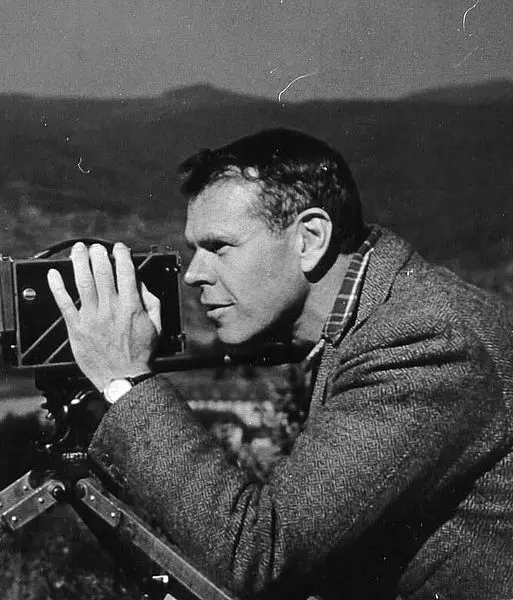
Influenced by Jean Cocteau's Le sang d'un poète (1931) and Carl Theodore Dreyer's La passion de Jeanne d'Arc (1928), he experimented with different film cameras, including the Eastman Kodak Specials. Experimentation would run through all his work, from documentary to fiction. He made several short films in which he painted on negatives or worked on scenes in reverse.
At the same time, he made documentaries about famous people. He spent several years with some of them in order to be able to shoot, for example Grandma Moses (1950), a short film about the American folk artist, and Albert Schweitzer (1957), for which he won an Oscar for best documentary. He then worked on a film about C.G. Jung, which he never completed, but whose ideas influenced his films in later years. This was the case for his first fiction feature, The Sand Castle (1961).
Film Portait (1972), considered his most important work, is a filmed autobiographical essay in which he explains his lifelong relationship with cinematic art. He juxtaposes film archives from his childhood with scenes from his adult life, often colorized and animated by hand. Some of these were filmed in Cassis, and part of the film crew, including first assistant Antoine Vernier, is a native of Cassis. The film was presented at the Cannes Film Festival in 1972.
« No, Jerome Hill didn’t receive proper recognition during his life. From his friends, yes: Stan Brakhage, Peter Kubelka, P. Adams Sitney, James Broughton, a few others saw his work and praised it and told him what a great artist he was. ‘Film Portrait’ will remain among the masterworks of cinema-‐a masterwork of form, of treatment of an era, an extraordinarywork of animation and color." Jonas Mekas
The fortune he inherited enabled him not only to devote himself to his own creation, but also to support the experimental film scene and various artistic and humanities disciplines. Throughout his life, he supported individual artists, as well as the creation of structures to support experimental art and research.
From the 1960s onwards, Jerome Hill began to consider formalizing his support. In 1964, he created the Avon Foundation, based in Saint Paul, Minnesota. The by-laws state that the donor/founder wishes to remain anonymous. The Foundation initially supported various organizations in the arts and humanities, with a particular focus on avant-garde cinema. Avon was renamed the Jerome Foundation after Jerome Hill's death. Its mission evolved to support emerging artists residing in his home state of Minnesota or in his former city of residence, New York.
In 1967, he created the Camargo Foundation to support artists, scholars and writers.
 Jerome Foundation