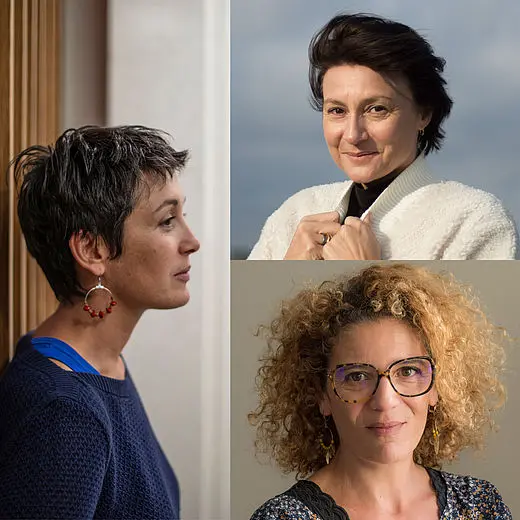
Leyla Dakhli, Elsa Dorlin & Caroline Meyer Picard
Historian, Philosopher & Choreographer
Biographies
Leyla Dakhli is a full-time researcher in the French Center for National Research (CNRS), presently settled in the Marc Bloch Center in Berlin. She is a historian, and her work focuses particularly on the study of Arab intellectuals and cultural history of the South Mediterranean region. She has a special focus on the social history of intellectuals—women and exiled intellectuals and activists in particular—and on the question of languages in the Mediterranean region, considered as a way to understand its entangled history. She is member of the scientific committee of the International Review of Social History (Amsterdam) and Le Mouvement social (Paris), and she contributes regularly to the Lebanese journal Al-Safir al-Arabi, the web-journal La Vie des idées, and Jadaliyya. She is the principal investigator of the project DREAM – DRafting and Enacting the Revolutions in the Arab Mediterranean (European Research Council Grant 2018-2023). She founded the European Society of Authors, dedicated to promoting translation and ideas’ exchanges.
Elsa Dorlin is Professor of social and political philosophy at the University of Paris VIII Vincennes/Saint-Denis (France). Previously, she was Associate Professor of History of science and History of Philosophy at the University of Paris I Panthéon-Sorbonne and, in 2009, she won the bronze medal of the Centre national de la recherche scientifique (CNRS) for her work on feminist theory and philosophy of gender. She has been Visiting Associate Professor at the Critical Theory Program of the University of California, Berkeley (2010-2011), and recently Abigail R. Cohen Fellow at the Columbia Institute for Ideas and Imagination (2018-2019). A specialist in the philosophy of Michel Foucault and continental philosophy, Dorlin’s research also focuses on Marxism, black feminist epistemology and Fanonian and decolonial phenomenology. She is the author of several books and articles, included La Matrice de la race. Généalogie sexuelle et coloniale de la Nation française (Paris, La découverte, 2006). Her latest book Self-defense: A philosophy of violence (Paris, Zones, 2017), winner of the 2018 Frantz Fanon Book Prize from the Caribbean Philosophical Association, has been translated in eight languages and is forthcoming in English (Verso).
Trained at the Conservatoire National Supérieur de Paris, Caroline Meyer Picard joined the Béjart Ballet Lausanne in 1990 before meeting Maguy Marin in 1994. World tours, political and social commitment, creations mixing dance, theatre, music, improvisation... The choreographer will remain a reference in her artistic career. In 2003 she joined the Felix Rückert Company in Berlin, where she discovered a work in intense interaction with the public. In Berlin, she performs for Sommer Ulrikson, Eun Me Ahn, Tchekpo Dan Agbetou, Arthur Kuggeleyn and the actress Corinna Harfouch. Since 2003, she has created several choreographies, including "Cellule 401" at the Ferme du Buisson, "Auto-Mata" at La Villette, "Anna-Luise" at the Sophiensaele and "Ibeji", a co-production between the Sophiensaele in Berlin and Chad. In 2011, she started to deepen her knowledge of body awareness and somatic work. She became a Reiki practitioner, Pilates coach and trained as a mindfulness meditation facilitator. Her creativity is put at the service of her pedagogy which never ceases to question the sensitive body in movement. Since 2018, she has been teaching dance technique at the University of the Arts in Berlin. Through experimentation and theory, she offers a space to explore sensations, emotions and feelings through dance movement.
Project: European Pavilion
Within the framework of the European Pavilion initiative, Camargo invites French-Tunisian historian Leyla Dakhli to lead a collective process entitled Translating Resistance, Smuggling Utopia. Consisting of researchers, translators, artists, and activists, the collective will share, read, compare, and discuss texts, archives, and ideas to retrace some trajectories of resistance and utopian thinking in Southern Europe and the Mediterranean.
In December 2021, Leyla Dakhli has come to Camargo for a 5-day residency in Cassis. As the curator of this program, she extended this invitation to philosopher Elsa Dorlin and Caroline Meyer Picard. Together they started an initial discussion on the possible angles, questions, materials and forms they would like to explore throughout the process.
In February, the trio returns to Camargo to pursue their reading and translation of political and poetic texts that challenge the very concept of border. During this workshop, a few threads will be pulled from a tangle of words, images, sounds, and ideas, to be weaved into more tangible directions. An actual bibliography of texts to be translated will start taking shape, which may include fragments of manifestos, poetry, speculative fiction, ethnographic writing, and scientific literature.
Beyond the soothing rhetoric about the Mediterranean, the sea in the middle of the earth, the mare nostrum lost and to be found again, the Pavillon des résistances establishes a space of refuge to carry voices, emotions and feelings. It works on the very notion of resistance as one works on a material to give it the capacity to accommodate fragility, tenderness, power and strength all at once. Like a sail made of a subtle weave that stretches and becomes rigid and powerful, the pavilion unfurls and unfolds in a multitude of senses.
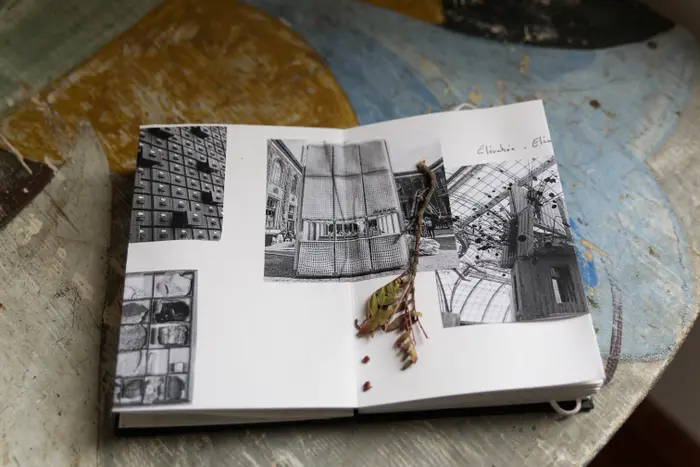
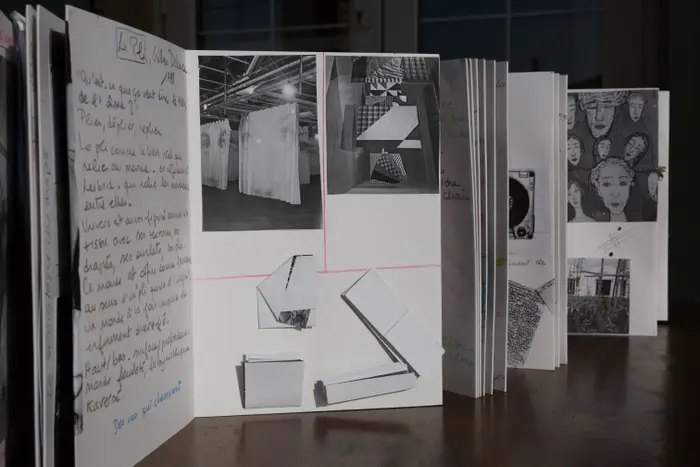
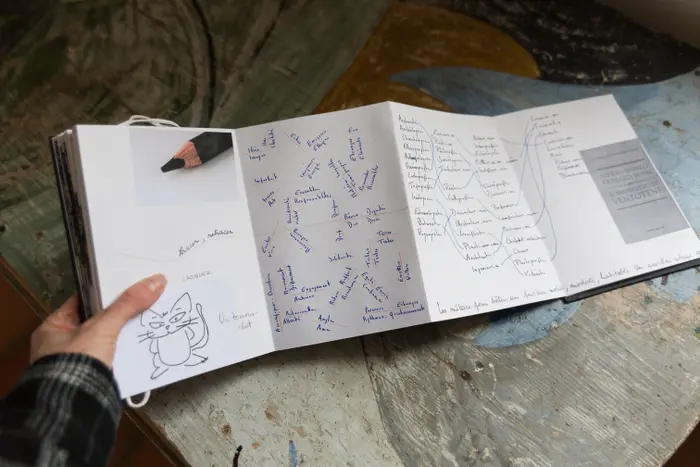
Encapsulated in the languages and sounds we wish to convey in our translations, passages, interpretations and emotions find shelter in the pavilion, which we conceive as one of those leporellos Ethel Adnan loved so much. The leporello combines the link we have with a diary, containing lists of loves and objects picked up along the way, with the ability to unfold to create a more or less open, more or less complex space.
Our memories of Ethel Adnan are not only of her pleasure in unfolding her soul on these small folded papers, but also of her synesthesias, the correspondences she invites us to trace between ourselves and the world, between our senses, between words and colors, sounds and materials. It is in these sensory passages that the pavilion is established, built like a house of paper, canvas, fabrics and weavings. It's made up of screens whose transparency, opacity, thickness or breakthroughs are envisaged as ways of saying and feeling the work, the words, the songs, the archive that they will contain.
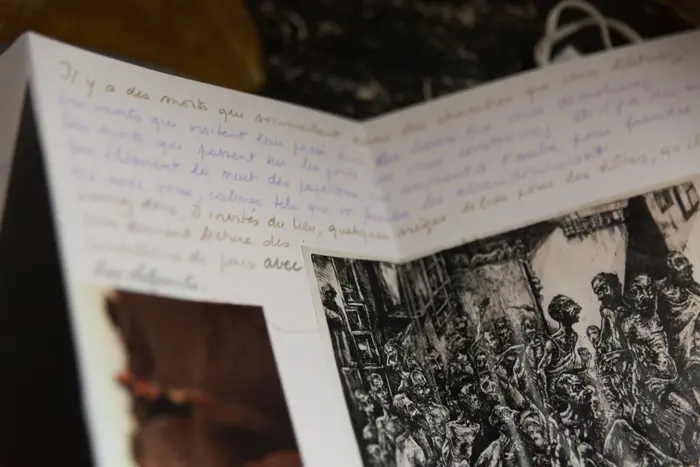
As a space for collecting, our pavilion welcomes the emotion of the archive. The emotion that makes the trace we find (that we uncover), that we touch, carry within it the traces of the hand that sculpted it, the contours of the spaces that saw it come to life, that contained it, and even that of its present in front of us: a tender scratch, a stain, a horny page. It also carries within it the violence that has been imposed upon it: a line that crosses, a stamp that grants or forbids... all the traces are superimposed, overlapping like sedimentation.
It arouses a particular emotion, similar to that of a reunion, containing an ever-present nostalgia and a form of mingled relief and powerlessness: rediscovering something that will never be again, and whose existence has become infinitesimal. Through translation, revival and reinterpretation, it is charged with the hope of new lives, new circulations and new incarnations.
The emotion of the archive brings us face to face with what remains, what has been deposited or collected, preserved with care, and this is what we wish to rediscover in a space of care. The gesture of care that brings us together is based on the daily practices of welcoming, those that make us feel at home.
In this space, then, no show or performance, no commission, but rather the gesture of re-giving, of putting into dialogue words and works that have already taken place, that have been composed elsewhere and that carry this history within them, objects, sounds and words that make up an archive and that are recycled, transformed by the encounter and the context that surrounds them.
So the pavilion space must be able to have folds and hollows, to unfold and close to contain. We see this pavilion as a space that contains worlds, that resembles a book, one of those pop-up books for children: it can be transformed, dismantled but also transported, moved, deployed in the environments that wish to welcome it: a clearing, a harbor, a pontoon, a wasteland, a school, a hill.
It then finds its place in the living world, thanks to those who come to inhabit and colonize it. It changes with the winds, the lights and reflections, the humidity or dryness. It may decide to remain to confront these elements, melting, wearing away, transforming itself through contact, thus acquiring a “mortal” nature despite the illusion of archiving and conservation. It can also live differently, like a utopia that is transformed as it passes from hand to hand, like a space for experimentation.
The first Leporello was the result of our first experiments, and was nourished by the words and echoes that emerged between us. It formed a shared territory. Others would follow, circulating and sharing with still others. It will then become the stowaway pavilion of our resistances, which may simply reside in what we have already experienced, in the languages we remember, the refrains we keep in mind, the scars of past suffering, or in the current cry of angry streets, the quivering of communities inventing and protecting themselves. A compendium of all these agile, multiform resistances, accepting their savagery as a gift and a weapon against barbarity.